Power cables
IEC-320
IEC-320 is a standard that unifies the use of power cables. These cables are mostly used to connect devices with higher power consumption, most commonly found in personal computers or monitors.
Connectors
There is always one plug (also called male) for each socket (also called female). They are usually shaped so that they are only compatible with each other, but there are exceptions, for example, C15 can be inserted into C14. Connector designations always begin with the letter C, followed by a number. In most cases, the socket number is an increment of the plug number with which it is compatible. For example, if the plug is marked C1, the socket will be C2, for plug C13 the socket will be C14, etc.

Types of connectors for the group with a plug in the device socket

C1 and C2
This type of connector was found on older electric shavers. It does not have a ground connection.

C5 and C6
Also known as "Mickey Mouse" or "cloverleaf." They are found mainly on laptop power supplies, projectors, LCD monitors, and televisions.

C7 and C8
The loop-shaped or horizontal figure-eight connector is mainly used for low-voltage devices, such as cassette and CD players and recorders, laptop power supplies, game consoles, and other audio and video equipment. It does not have a ground connection.

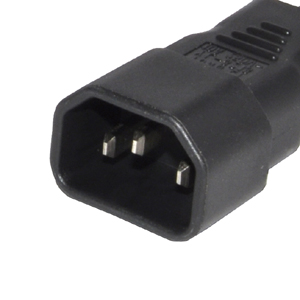
C13 and C14
A very common pair found on almost every personal computer, monitor, uninterruptible power supply, game console, many servers, and all kinds of professional audio and video equipment.

C15 and C16
Similar to the C13 and C14 connectors, with the difference that C15 and C16 have increased temperature resistance and a slightly modified shape. Thanks to this advantage, they are mainly used for kettles, coffee makers, and similar appliances that produce high temperatures.
The maximum temperature that the connector can safely withstand is 120°C.
The C15 connector can be inserted into a C14 socket, but the C13 plug does not fit into a C16 socket.

C15A and C16A
A connector similar to C15 and C16, with the difference that it has an even higher maximum temperature of 155°C and a different shape.

C17 and C18
These are similar to C13 and C14, with the difference that they do not have grounding. However, the C18 socket is compatible with the C13 socket.
Mostly used in older devices such as electric typewriters and televisions.

C19 and C20
C19 and C20 are not commonly encountered by ordinary users; they are mostly used to power various IT devices that may require higher current. Examples include servers, uninterruptible power supplies, more powerful computer power supplies, various network components, and medical devices.
Connectors that have been removed from the standard are not listed here.
CEE7
Various types of sockets and plugs are used around the world for power supply. CEE7 is one of the unifying standards for these sockets and plugs.
CEE7/1 socket and CEE7/2 plug
This is an ungrounded socket and plug that is no longer widely used around the world and is even banned from use in new buildings in Sweden. It is a round plug with two prongs. The socket has two sockets and no grounding pin.

CEE7/3 socket and CEE7/4 plug (Type F / "Schuko")
The most widespread version of the German CEE7 standard, which is now used in more than 35 countries. It is a round socket with two pins and two special cutouts with spring contacts for grounding.

CEE7/5 socket and CEE7/6 plug (Type E)
French version of the CEE7 standard. It is a round socket with two pins and one input for a grounding contact. The socket has two input holes for pins and one grounding pin.

CEE 7/7 (compatible with CEE7/5 and CEE7/3 sockets)
This is a simplification and unification of two CEE7 standards, specifically CEE7/4 and CEE7/6. This plug has both an input socket for a grounding pin and two spring contacts for grounding CEE7/3 sockets.

CEE7/16 plug
This is a plug without a grounding contact. There are two versions, but the best known is probably the "Europlug" version. It is a flat plug with two pins and is compatible not only with CEE7/1, CEE7/3 and CEE7/5, but also with some completely different standards in other countries (e.g. Denmark, Switzerland).
